
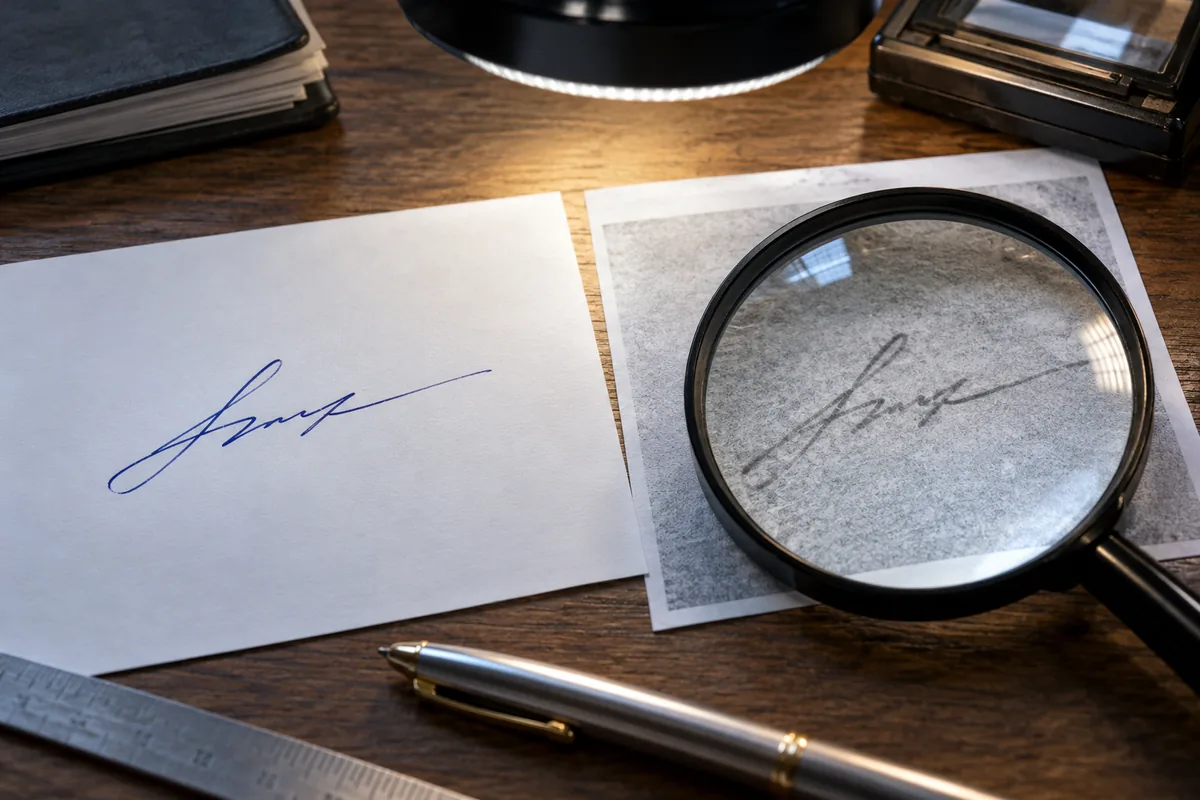
A document copy may contain useful information about the form of the handwriting, but it does not reproduce every property of the original stroke and material. Its suitability must therefore be assessed for the specific task, rather than by a general rule that “a copy is always suitable” or “a copy provides nothing”.
What is lost through copying
Scanning, photography, printing and compression can alter visible contours and conceal features associated with the execution of strokes. A copy may not reveal properties needed to check for technical reproduction of a signature. These limitations must be assessed before giving a categorical answer about who wrote it.
How to describe provenance
- State whether the original exists and who holds it.
- Describe how the copy was obtained and any known transformations.
- Preserve the original scan or photograph file without enhancement.
- Provide the entire document, rather than just the cropped signature.
- List the available comparison specimens and information about their provenance separately.
Do not enhance the only copy
Filters, tracing, increased contrast and background removal can create false impressions of stroke structure. A separate working version may be used for explanation, but the original file must be preserved and kept distinct from it. A reprinted image does not become the original document.
Comparison specimens also need assessment
The known writer, time, conditions and comparability matter. Signatures in random files with no provenance should not be accepted as reliable specimens. When short signatures are compared, it is especially important to identify the information missing from the copy before choosing how to formulate the question.
What the conclusion should state
The expert describes which features are available, which checks are limited and how this affects the answer. A probabilistic conclusion must not be turned into a categorical one when summarised, nor may an inability to resolve the question be presented as confirmation of one of the possible explanations.
If the original becomes available later, further assessment of the task and materials may be needed. The earlier report based on a copy must not create the impression that every property of the original document has already been examined.
At the initial enquiry, it is useful to describe the document's condition, the availability of the original and how the file was obtained, as well as the wish to “check the signature”. This allows the actual possibilities of examination to be discussed before specimens are submitted and the work is agreed.